
India's retail inflation rose to 4.38 per cent in June, driven primarily by costlier food items, pushing it above the Reserve Bank of India's median target of 4 per cent for the first time under the new series.

India is likely to see above-normal rainfall in the four-month monsoon season (June to September) with cumulative rainfall rainfall estimated at 106 percent of the long-period average (87 cm), he said.

Addressing a press conference virtually, India Meteorological Department Director General Mrutyunjay Mohapatra said September was likely to witness normal rainfall in the range of 91-109 per cent of the long period average of 167.9 mm.

India's wholesale price inflation surged to 8.30 per cent in April, up from 3.88 per cent in March, primarily driven by a significant increase in the prices of fuel, power, and crude petroleum, according to data from the commerce and industry ministry.

'It is not because of the war in West Asia, which began on February 28.' 'Petroleum product prices are already going through the roof. They are bound to have a serious inflationary impact.' 'A country's leadership is tested in trying times. It is here that the current leadership is failing.'
The country can expect normal rainfall during the southwest monsoon season as a positive Indian Ocean Dipole (IOD) and a lower snow cover over the northern hemisphere are likely to counter the evolving El Nino conditions, the India meteorological department (IMD) said on Tuesday.

ITC reported a 6.1 per cent year-on-year growth in its consolidated adjusted net profit from continuing operations, reaching ~5,469.74 crore in the January-March quarter (Q4FY26), primarily fuelled by strong performances in its cigarettes and non-cigarette fast-moving consumer goods (FMCG) businesses.

Also, the monsoon this year may end up being the driest since 2015, which recorded a rainfall deficit of 13 per cent, they said.

Even if there is an early agreement on a cessation of hostilities in West Asia, the price shock will not go away easily, points out A K Bhattacharya.

Revenue collection next financial year may be affected, and, along with this, subsidies on food and fertilisers can go up if the war in West Asia drags for long, according to experts.

The Reserve Bank of India (RBI) Governor Sanjay Malhotra is now confronting the classic growth-inflation tradeoff, a situation exacerbated by the West Asia war, which threatens to end the 'goldilocks period' of low inflation and robust growth.

El Nino refers to abnormal warming of surface ocean waters in the Pacific that disrupts weather pattern causing drought and floods in many regions of the world.

'Monsoon is the pran (life) of our water system.' 'A weak monsoon will have a very negative impact on crops and people's lives.'

East and northeast India recorded 29 per cent rain deficit -- 141.5 mm against the normal of 199.9 mm -- from March 1 to May 3.

June rainfall accounts for 15 percent of the total precipitation of 87 cm recorded during the four-month monsoon season in the country.

'Can you believe there are over 26,500 deaths linked to heatwave-driven ozone in 2024?'

The El Nino risks for this year is rising in India and it could result in sub-par rains, says a report.

East India, along with a major portion of central India, is likely to be at a higher risk of being rain deficient, especially during the first half of the season.

Sri Lanka and southern India could continue to experience higher than normal rainfall and this could cause further flooding, particularly urban flooding, in certain locations, the report said.

Dozens of farmers have already committed suicide in India after damage from unseasonal rains this year.

The IMD DG said there should not be an impression that climate change leads to rise in the temperature, but on the contrary, it leads to erratic weather.
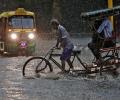
Though early days, meteorologists point towards a neutral La Nina during the initial phase of the four-month monsoon season this year that starts from June. If this holds true, by the time the rains hit the mainland, it could mean there would be one less reason to worry about the prospects of the monsoon this year. Weathermen said making any accurate prediction of how El Nino will behave and what impact it can have on the progress and distribution of rains is difficult to say at this point. A clear picture will emerge around late May or early June.

India's peak power demand is projected to hit 270 GW this summer, surpassing last year's record of 250 GW.

The World Meteorological Organisation (WMO) has officially confirmed that 2023 is the hottest year on record by a huge margin, smashing global temperature records.

India is set to experience extreme heat during the April to June period, with the central and western peninsular parts expected to face the worst impact, the IMD said on Monday as the country prepares for seven-phase general elections from April 19.

El Nino is expected to occur in August-September, but it is unlikely to have any major impact on the monsoon, and the weatherman expects a positive Indian Ocean Dipole, which has a strong influence on rainfall in the country.
The exercise, Agriculture Minister Radha Mohan Singh said, will help ease any possible impact of sub-par rainfall on farmers.
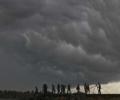
For the second successive year, Monsoon is likely to be below normal with parts of north-west and central India to be the most affected.
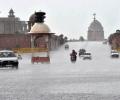
The IMD chief also allayed fears of occurrence of an El-Nino.
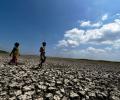
'The first two months of monsoon are not looking good.' 'In case both the halves fail, it is going to be misery.'
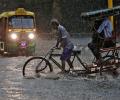
Monsoon is likely to be 96 per cent of the long period average

According to the global financial services major, inflation may remain sticky, with a possible El Nino effect on the monsoon likely to push up food prices and geopolitical uncertainties seen pumping up global commodity rates.
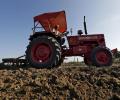
After a stellar run on the bourses that saw tractor stocks rise up to 52 per cent, analysts are turning cautious on the sector as muted demand trends may weigh in the near-term. Total volumes in the tractor segment for the last three quarters of the current financial year (9MFY24) have remained weak with VST Tillers, Escorts Kubota, and M&M seeing declines of 21 per cent, 5 per cent, and 3 per cent year-on-year (Y-o-Y), respectively, during the period, amid patchy rainfall, delayed crop harvest, and lower reservoir level. Across industry, total domestic sales volume so far in the current financial year (April '23 to January '24) has declined 5 per cent Y-o-Y, as per Tractor Manufacturers Association (TMA).

The five warmest years in Indian weather history have occurred in the past 14 years -- the others being 2009, 2017 and 2010, in order of intensity.

Prime Minister Modi last week called for optimal grain storage, fire audits and mock drills in hospitals as preparations for the harsh summer forecast by the meteorological department.

The planet experienced its warmest January on record last month despite the development of La Nia, a climate pattern that usually brings cooler global temperatures, the European climate agency said on Thursday. This comes on the heels of the Earth experiencing its hottest year on record in 2024, also the first to see global average temperatures rise 1.5 degrees Celsius above pre-industrial levels. According to the Copernicus Climate Change Service (C3S), January 2025 recorded an average temperature of 13.23 degrees Celsius, 0.09 degrees warmer than the previous hottest January (2024) and 0.79 degrees above the 1991-2020 average. Scientists also found that the Earth's temperature in January was 1.75 degrees Celsius higher than pre-industrial levels. Global temperatures have stayed above the 1.5-degree mark for 18 of the last 19 months.

'In FY23, PV sales are expected to end the year at a record 3.8 million units, up 26 per cent. In FY24, however, the industry is expecting 5-7 per cent volume growth'

While weather forecasters remain divided on how the monsoons will play out in India over the next few months, analysts believe the news at the current juncture - at best - can trigger a knee-jerk reaction in the markets. They believe it is too early to say whether the sub-par monsoon on account of El Nino can seriously dent the market sentiment in the short-to-medium term. "These are just initial forecasts and we will have another round / status update from the weather forecasters a month down the line.

"The season averaged maximum temperatures in Himachal Pradesh, West Rajasthan, Konkan, Goa, Coastal Karnataka, Kerala and Arunachal Pradesh are likely to be higher than normal by 0.5-1.0 degree Celsius," the Met department has said in its forecast.

The warmest six years have all been since 2015, with 2016, 2019 and 2020 being the top three. The differences in average global temperatures among the three warmest years are indistinguishably small. The average global temperature in 2020 was about 14.9C, 1.2 ( 0.1) C above the pre-industrial (1850-1900) level.
